A sweeping review of more than two decades of climate science has found that research into the Earth’s most critical climate tipping points is strikingly uneven — with some systems attracting thousands of studies while others, potentially just as close to collapse, have been examined only a handful of times. The findings, published in Proceedings of the National Academy of Sciences, raise questions about whether scientific attention is being directed where it is most urgently needed.
Researchers analyzed 20,736 scientific publications on 14 climate tipping elements published between 2000 and 2025. These tipping elements — parts of the climate system that can shift abruptly and potentially irreversibly once warming crosses a critical threshold — include the Greenland and Antarctic ice sheets, the Amazon rainforest, coral reefs, and major ocean circulation systems.
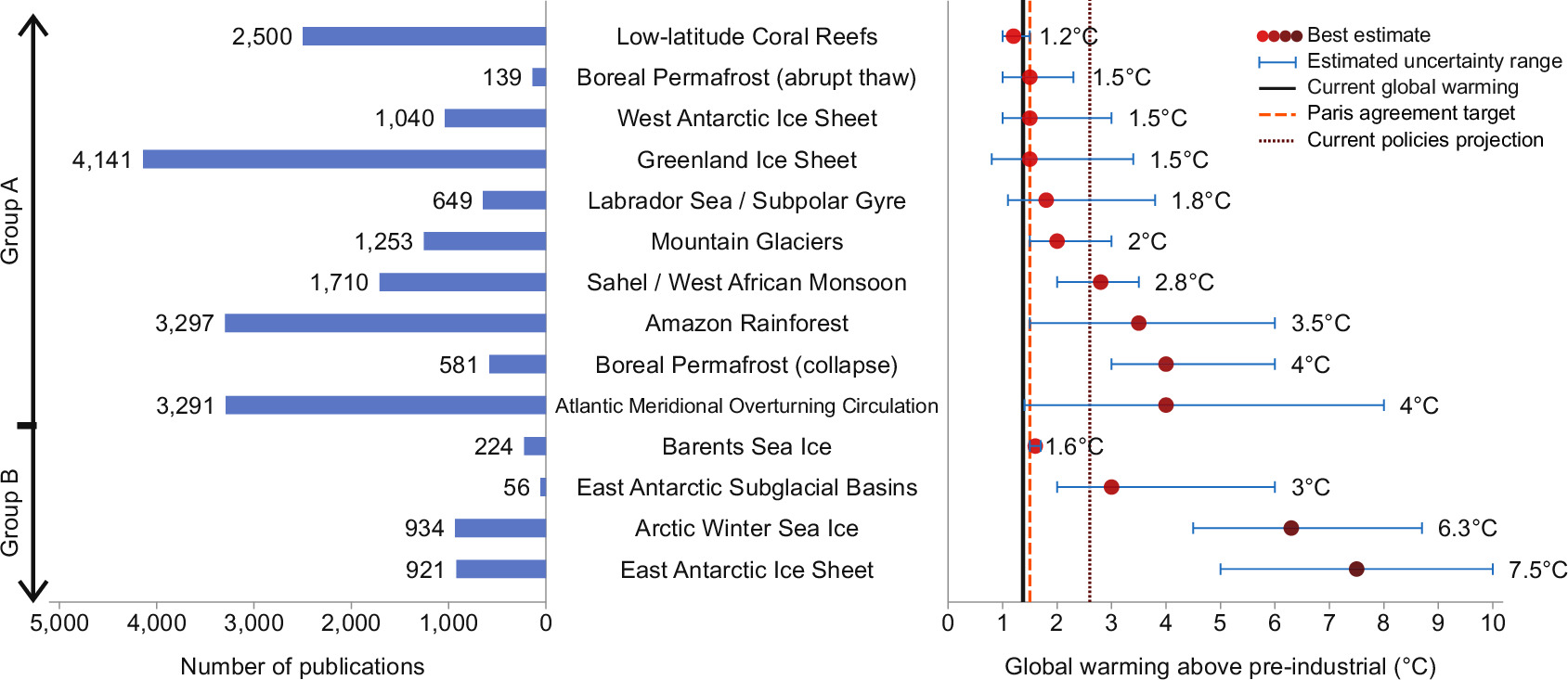
The study found that the Greenland Ice Sheet alone accounted for 4,141 publications, or roughly 20% of the entire dataset. By contrast, abrupt thaw of permafrost in boreal forests appeared in just 139 papers, representing 0.7% of the total, while the North Atlantic subpolar gyre was covered in 649 papers, or 3.1%.
What makes the imbalance particularly notable is that it does not appear to track with how soon a given system might tip. The study compared research volume against published estimates of the warming thresholds at which each system could cross a tipping point. Abrupt boreal permafrost thaw has a best-estimate threshold of around 1.5°C above pre-industrial levels — the same as Greenland’s — yet receives a fraction of the research attention. The North Atlantic subpolar gyre’s estimated threshold sits at around 1.8°C. The researchers found no systematic tendency for lower-threshold tipping elements to attract more scientific scrutiny.
Beyond which systems scientists study, the research also examined what aspects they focus on. The defining characteristics of tipping points — abrupt change, self-reinforcing dynamics, persistence in a new state, and irreversibility — were explicitly examined in only 8.1% of the publications analyzed. The gaps were stark for specific systems: across 26 years of research, just 22 peer-reviewed studies examined these risk-relevant dynamics in abrupt boreal permafrost thaw, and only 53 did so for the North Atlantic subpolar gyre. Low-latitude coral reefs were similarly underexamined in this respect.
The authors are careful to note that unequal publication counts are not inherently problematic — some systems have longer observational records, are easier to model, or sit within more established scientific fields. The Greenland Ice Sheet and the Atlantic Meridional Overturning Circulation, for instance, benefit from decades of infrastructure and large research communities. Nor does paper count reflect the quality or certainty of the science.
The study argues that research priorities are shaped collectively, through funding decisions, institutional focus, and where monitoring capacity is built — and that those collective choices may be leaving consequential risks underexplored. The authors suggest that identifying and addressing these gaps before the climate system reaches those thresholds is a practical and pressing priority for both scientists and policymakers.