Australia’s first National Climate Risk Assessment finds that climate change is already affecting the systems Australians rely on and that risks will intensify and cascade without stronger, coordinated adaptation.
Introduction
Australia’s first National Climate Risk Assessment presents a stark conclusion: climate change is already affecting the systems that support Australian life, and the risks will become broader, more severe and more interconnected as warming continues. The 2025 overview, prepared by the Australian Climate Service, assesses risks to communities, health, the economy, infrastructure, primary industries, ecosystems, national security, supply chains and water security. It is intended to give governments, businesses, industries and communities a nationally consistent evidence base for adaptation.
The assessment does not attempt to predict a single future. It examines how risk changes across current conditions, the medium term around 2050 and the longer term around 2090, and at global warming levels of 1.5°C, 2°C and 3°C above pre-industrial temperatures. Its central message is that historical experience alone is no longer a reliable guide. Hazards are changing in frequency, intensity, duration, timing and location, while events increasingly occur together or in rapid succession. These compounding and cascading effects can turn a local disaster into disruption across many sectors and regions.
How the assessment was developed
The Australian Climate Service used a risk-based approach aligned with international practice and the Intergovernmental Panel on Climate Change. Risk is treated as the interaction of four elements: the climate hazard; the people, assets or ecosystems exposed to it; their vulnerability; and the effectiveness or limitations of existing responses. Importantly, the ratings describe residual risk – the risk remaining after current mitigation and adaptation measures are considered.
A first-pass assessment reviewed risks across eight nationally important systems and identified 56 nationally significant climate risks. The Australian Government then selected 11 priority risks for detailed quantitative and qualitative analysis. These included risks to coastal and regional communities, health and wellbeing, critical infrastructure, natural ecosystems, primary industries, the real economy, water security, supply chains, governance, and disaster response and recovery. Separate engagement identified seven nationally significant risks for Aboriginal and Torres Strait Islander peoples. The work involved more than 2,000 workshop participants, 254 climate-risk experts and authors, 41 key workshops, 11 geographic regions and more than 15 new national datasets.
The authors acknowledge important limits. Evidence and data are uneven, particularly for some future impacts and for judging the effectiveness of current adaptation. Risk ratings therefore include confidence levels. The assessment is best understood as a national baseline to be strengthened through monitoring, further research and repeated assessment, rather than a final or complete account.
Australia’s climate hazards are changing
The report considers ten priority hazards: temperature change and extremes; drought and aridity; bushfires, grassfires and air pollution; extratropical storms; severe convective storms including hail; tropical cyclones; riverine and flash flooding; coastal and estuarine flooding; coastal erosion and shoreline change; and ocean warming and acidification.
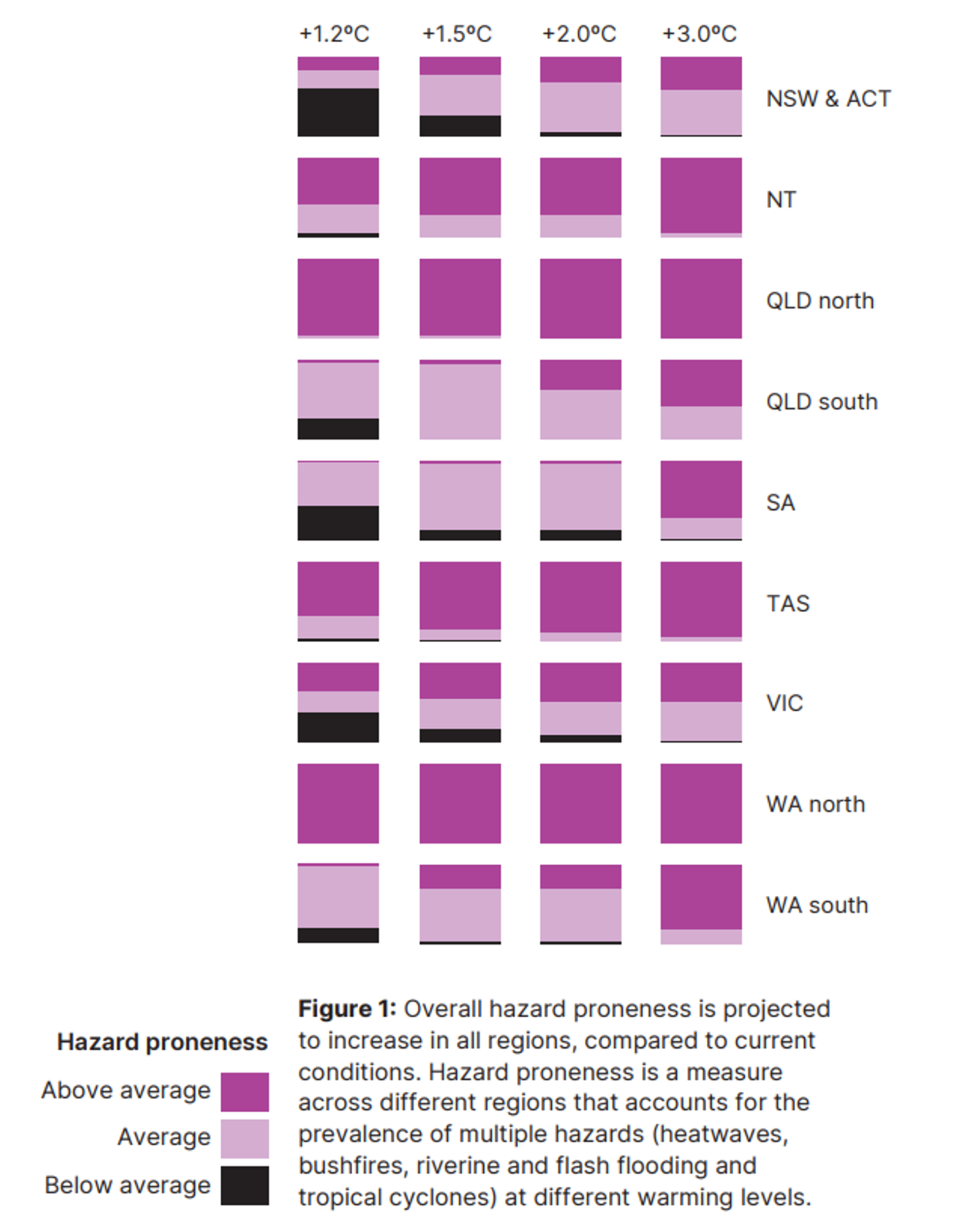
Australia is likely to experience more intense extremes, sometimes in places with limited previous experience of them. Hotter conditions will increase heatwaves and dangerous fire weather. Sea-level rise will intensify coastal inundation, flooding and erosion. Rainfall patterns, drought and water availability will shift, while warmer and more acidic oceans will place marine ecosystems under increasing stress. The distribution of risk is not uniform: northern Australia, coastal settlements, outer urban areas, regional and remote communities, and locations dependent on climate-sensitive industries emerge as important watchpoints.
The most consequential change may be the interaction among hazards. Floods, fires, heatwaves and storms can occur concurrently, compound existing disadvantage, damage the same infrastructure repeatedly and shorten recovery time between events. Failure in electricity, telecommunications or transport can then disrupt health care, food, fuel, medicines, banking and emergency response. The report repeatedly emphasises that climate risk is systemic rather than a collection of isolated environmental problems.
Communities and national security
Risk to urban, regional and remote communities is rated Moderate under the current climate and projected to reach Very High-Severe by 2050, with high confidence. Coastal exposure is a major driver. By 2050, the share of coastal communities in high or very high-risk areas is projected to rise from 8% to 18%. If today’s population distribution remained unchanged, more than 1.5 million people would be exposed. By 2090, 34% of coastal communities could be in high or very high-risk areas, representing more than three million people on the same population basis.
Outer urban areas are vulnerable because exposure can coincide with socioeconomic disadvantage, limited services and infrastructure that is not designed for future conditions. Remote communities often have weak supply chains and limited redundancy in power, telecommunications, transport and water. Repeated disasters may cause displacement and domestic migration, disrupting employment, local economies, social networks, cultural heritage and community cohesion.
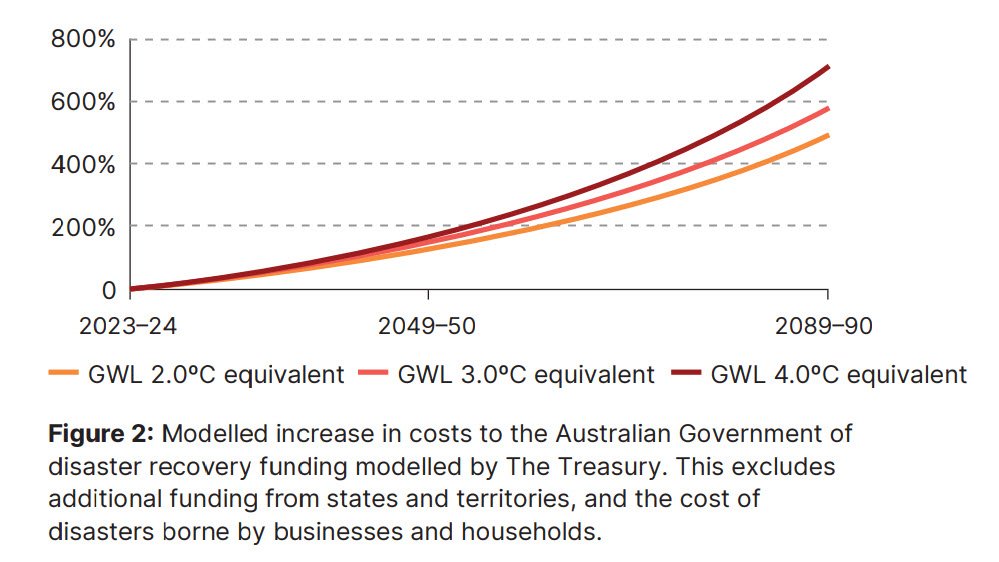
Climate risk to defence and national security is already rated High and is expected to rise to Very High-Severe by 2050. More frequent, severe and concurrent disasters will stretch emergency services, volunteers, governments and the Australian Defence Force. Average Australian Government expenditure under Disaster Recovery Funding Arrangements could be five times higher by 2090 under an equivalent 2°C warming scenario, and 7.2 times higher under a scenario below 4°C. Growing reliance on Defence for domestic disaster response may also compete with its core mission and create public expectations that are difficult to sustain.
Economic and infrastructure risks
The economy, trade and finance system moves from Moderate current risk to a projected Very High risk by 2050, although confidence in the future rating is lower because financial outcomes depend on social, market and policy responses. Physical damage, disrupted production, reduced outdoor labour productivity, supply-chain shocks, insurance stress and asset revaluation can reinforce one another. Insured losses from declared catastrophes rose from 0.2% of gross domestic product in 1995-2000 to 0.7% in 2020-2024. The report cites projected disaster costs of $40.3 billion annually by 2049-50 under a moderate emissions scenario, including financial and social costs.
Housing and household budgets are central to the risk. Property damage and insurance premiums may rise while cover becomes unaffordable or unavailable in exposed areas. Losses in Australian property values have been estimated at $611 billion by 2050 and $770 billion by 2090, though the report stresses the substantial uncertainty in long-range financial projections. Heat may also reduce labour productivity: by 2063, the resulting reduction in economic output is estimated at $135 billion to $423 billion.
Infrastructure and the built environment are rated Low-Moderate today and High-Very High by 2050. Energy, telecommunications, transport, water, housing and coastal infrastructure are interdependent. A failure in one network can rapidly spread through others. Telecommunications assets currently have particularly high exposure to severe hazards, while regional transport networks can lack alternative routes. The number of homes classed as high risk could potentially double by 2100. Sea-level rise and storms threaten coastal cities, ports and other infrastructure, and heat can reduce energy generation and transmission efficiency just as electricity demand rises.
Health and social support
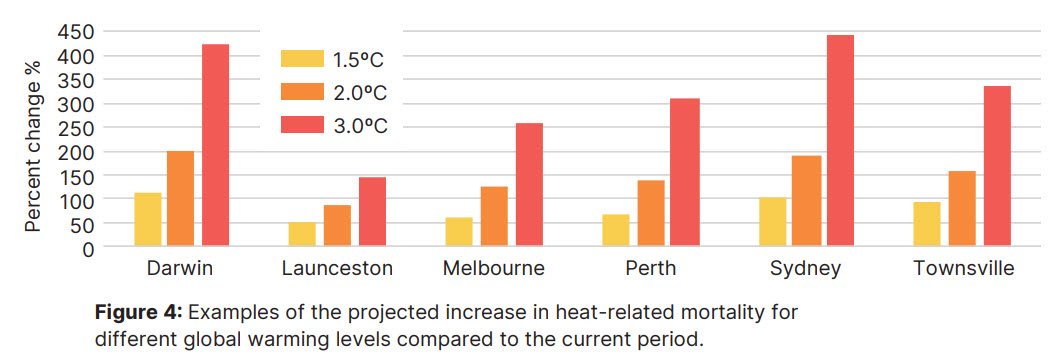
The current risk to health and social support is rated Moderate-High and is expected to become Severe by 2050. Extreme heat is a leading direct threat, increasing illness and mortality and exacerbating cardiovascular, respiratory and kidney disease. The rise in heat-related deaths is not linear: risk accelerates as temperatures climb, particularly between 2°C and 3°C of global warming. Smoke and poor air quality from bushfires add respiratory and cardiovascular harm, while floods and storms can injure people, contaminate water and interrupt access to care.
Mental health effects include distress, anxiety, grief and trauma following disasters, as well as the cumulative effects of displacement, financial strain and loss of place or livelihood. Climate-sensitive infectious diseases may expand or change their distribution as temperatures, rainfall and flooding alter the habitats of mosquitoes, ticks and pathogens. Health services themselves are exposed through damaged facilities, workforce pressure, disrupted transport and fragile supply chains for medicines and equipment.
Risk is distributed unequally. People with pre-existing illness, older people, young children, outdoor workers, people with disability, low-income households and communities with limited health access face greater harm. Aboriginal and Torres Strait Islander peoples may experience threats to the health of Country, access to Country, cultural practices and self-determination, with flow-on consequences for physical, social and emotional wellbeing. Addressing disadvantage and strengthening local services are therefore climate adaptation measures as well as social policy.
Natural systems, food and water
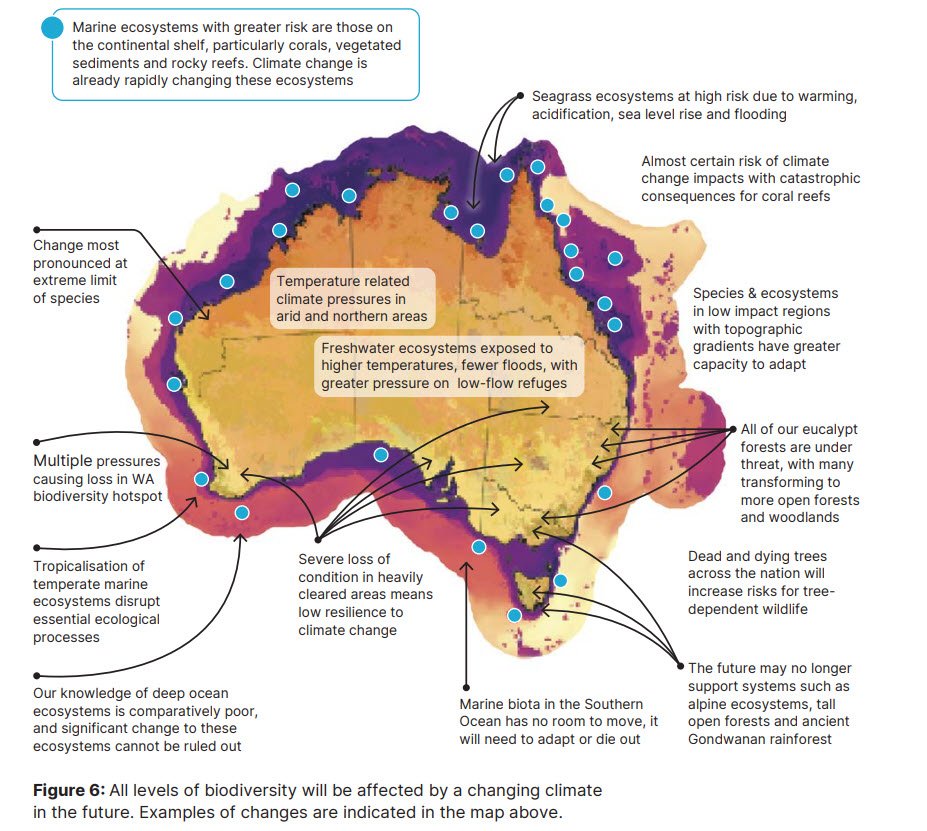
The natural environment has one of the highest present risk ratings: High-Very High now and Severe by 2050. Climate change is already affecting terrestrial, freshwater and marine ecosystems, some of which show signs of local collapse. Warming, altered rainfall, fire, invasive species, ocean acidification and marine heatwaves can reduce ecosystem resilience and push species beyond their climatic limits. At 3°C of warming, changes in species composition are projected across much of the continent. Loss of biodiversity also weakens services on which people depend, including water purification, pollination, coastal protection, food production and carbon storage.
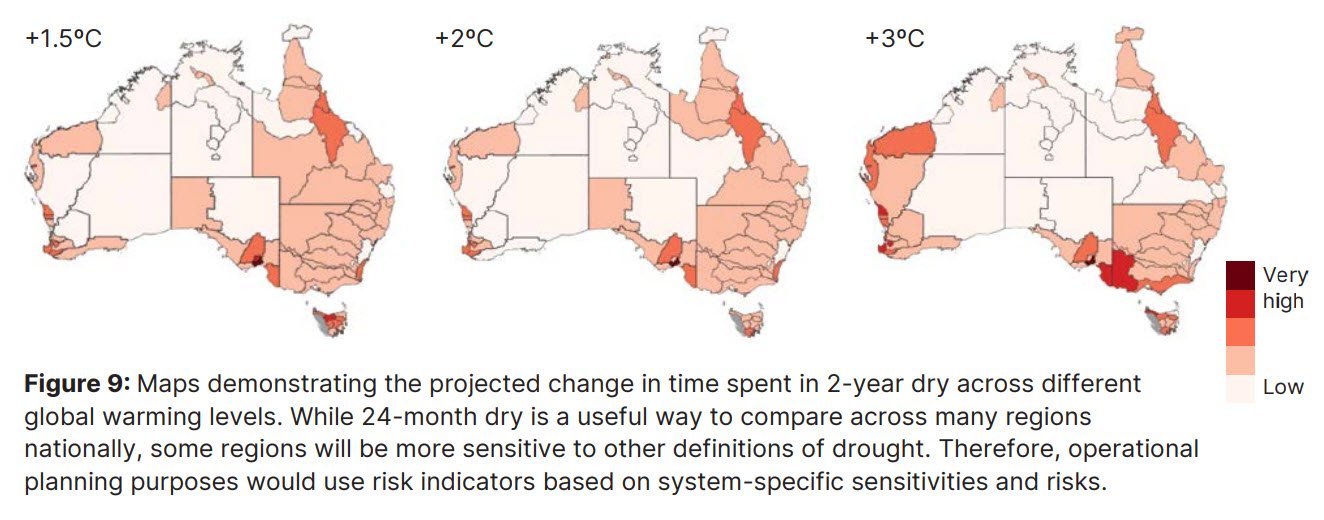
Primary industries and food are rated Moderate-High today and High-Very High by 2050. Cropping, livestock, forestry, fisheries and aquaculture face changing rainfall, extreme heat, drought, fire, pests and disease. Winter growing-season rainfall is projected to decline particularly in south-western and parts of southern Australia. Some cooler regions or particular industries may experience temporary benefits, but these do not offset the national pattern of increasing disruption, production volatility and biosecurity pressure. Farming communities carry both economic and wellbeing risks because livelihoods, identity and regional services are closely linked to agriculture.
Water security is a cross-system risk with consequences for communities, ecosystems, agriculture, industry and cultural heritage. Warming increases evaporation and reduces soil moisture, runoff and groundwater recharge, while severe droughts may last longer than those observed since European settlement. Floods and bushfires can degrade water quality through sediment, ash, nutrients, salinity and blackwater events. Cities may invest in diversified, climate-resilient supplies, but remote and smaller regional communities often face high infrastructure costs, skill shortages and few alternatives. The natural environment is expected to experience the most severe water-related impacts, especially where systems are already fully allocated or poorly managed during low flows.
Supply chains, governance and adaptation
Supply-chain disruption demonstrates how local hazards become national problems. Modelling of a flood similar to the October 2022 event in Victoria and New South Wales found that the value of blocked freight could rise from $4.9 billion in the current climate to $9.3 billion in 2090. Medicines and other health-related freight showed the largest proportional increase in value affected. A future severe cyclone following the path of Cyclone Jasper could create food shortages in distribution centres far beyond northern Queensland. A more severe repeat of flooding that closed the Eyre and Stuart highways produced average detours of 730 kilometres in 2090, with some reaching 3,200 kilometres and disproportionate effects on Indigenous and remote communities.
Governance determines whether these interacting risks are reduced or inadvertently transferred elsewhere. Effective adaptation requires clear responsibilities, collaboration across jurisdictions and sectors, equitable resources, community participation and decisions that account for uncertainty. The report’s stocktake found that identified adaptation activity is concentrated in knowledge-building actions (40%) and institutional actions (34%). Plans and policies are progressing, but the assessment identifies an action shortfall in every system and warns that planning does not automatically produce effective adaptation.
The priorities are practical: update standards and land-use decisions for future rather than historical conditions; strengthen critical infrastructure and supply-chain redundancy; protect health and emergency workforces; improve climate information and monitoring; and involve communities, including Aboriginal and Torres Strait Islander peoples, in decisions that affect them. Adaptation must work locally while recognising national interdependencies. It should also be monitored and revised as conditions, evidence and community needs change.
Conclusion
The assessment shows that climate change is not a distant environmental issue. It is a present and escalating risk to health, homes, livelihoods, public finances, national security, infrastructure, food, water and Australia’s distinctive ecosystems. The most serious impacts arise where hazards intersect with existing disadvantage, ageing systems and tightly connected networks. By 2050, every major system assessed is expected to face high, very high or severe risk.
Its purpose is not simply to catalogue threats. By identifying where exposure, vulnerability and response capacity combine to create residual risk, the report provides a basis for prioritising adaptation. Early, coordinated and equitable action can still reduce harm. The alternative is a future in which repeated disasters, ecosystem decline and cascading failures make recovery increasingly costly and difficult.
Source
Australian Climate Service, Australia’s National Climate Risk Assessment: An Overview (2025). Original Figure numbers and captions.