Every NHS ambulance service in England recorded some of its busiest days ever during the record-breaking heatwave of late June 2026, according to data obtained by Carbon Brief through freedom-of-information requests. The findings reveal the scale of pressure placed on emergency services as temperatures climbed past 37C and the government issued only its second-ever red extreme heat warning — a designation indicating “significant risk to life for even the healthy population.”
Four of England’s ten ambulance services, including London’s, saw unprecedented numbers of life-threatening category 1 responses — covering incidents such as heart attacks — on at least one day between 23 and 27 June. A further two services, covering the south-west and east of England, received their highest-ever total volume of 999 calls. On 26 June, the peak day of the heatwave, ambulances across England responded to 4,084 life-threatening emergencies. The normal summer daily average for such incidents is around 2,500. Researchers have estimated that nearly 3,000 heat-related deaths occurred across the UK this summer.
The strain was particularly acute in the south and east of England, where temperatures in some areas approached 38C. The South East Coast and South Central services — covering a region stretching from Oxfordshire to Kent — each recorded unprecedented category 1 callouts on three consecutive days: 25, 26 and 27 June. The South Western and East of England services both received record total call volumes on 26 June, the same day the highest-ever June temperature in the UK was recorded in Norfolk. Notably, the data shows that demand during the heatwave surpassed levels seen during both the traditionally busiest winter periods and, for most services, the height of the Covid-19 pandemic.
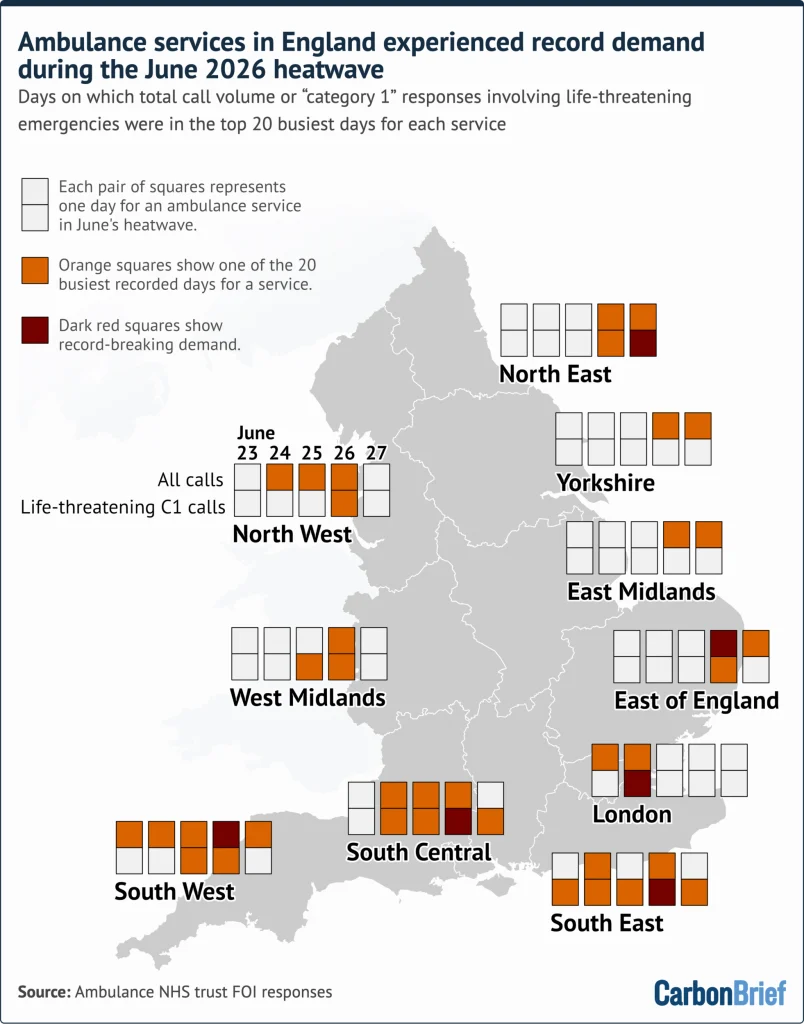
Ambulance services noted that extreme heat exacerbates a range of life-threatening conditions. Stu Holliday, head of emergency preparedness at North East Ambulance Service, said services typically see increases in calls related to dehydration, heat exhaustion and heatstroke during hot weather, as well as worsening of existing heart and respiratory conditions. He identified older people, young children and pregnant people as especially vulnerable. The UNISON union separately warned that ambulance crews themselves faced difficult conditions, including “stifling heat with faulty or no air conditioning” and continuous back-to-back callouts driven by surging demand.
The data also reflects a longer-term trend: ambulance demand has been rising for years due to an ageing population, increasingly complex health needs and growing mental health pressures, meaning 2026 as a whole is on track to be a record year for call volumes even beyond the heatwave period. The June figures, however, underscore how extreme heat events are now beginning to rival winter as the most intense periods of emergency healthcare demand in England.