One year ago, the Australian government published its National Climate Risk Assessment and an accompanying National Adaptation Plan — the country’s first systematic attempt to catalogue what climate change threatens and how the nation might respond. The anniversary has prompted a sobering stocktake from researchers involved in the project, who say little concrete action has followed the landmark documents.
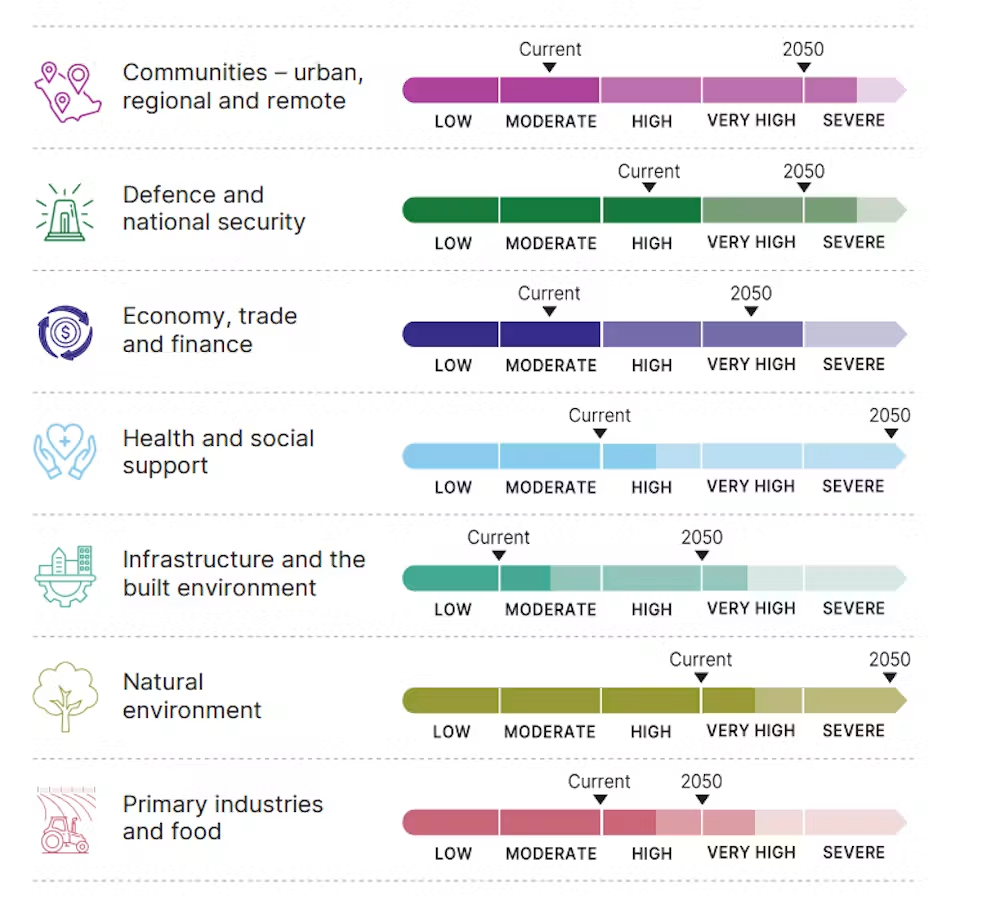
The assessment, completed by the Australian Climate Service at a cost of A$22.9 million and involving more than 250 experts, identified 63 nationally significant climate risks across eight sectors — from the financial system and defence to the natural environment. Among its findings: the financial cost of extreme weather in Australia has already tripled over the past three decades, with disaster recovery spending forecast to surge sevenfold by 2090; deaths from heatwaves alone could quadruple in some capital cities at 3°C of warming; coastal impacts could affect up to three million people by 2090; and up to 70% of native plant species could be living outside their current climate range by 2050. The report was itself delivered months later than planned, finally released on 15 September 2025 — well after the May federal election.
The climate backdrop has done little to soften the urgency. Australia endured its fourth warmest year on record in 2025 and its hottest ocean temperatures ever. A so-called “whiplash summer” brought flash flooding rapidly followed by bushfires that destroyed more than 500 properties — the worst damage since the 2019–20 Black Summer. Globally, the United Nations has warned the world is on track to overshoot 1.5°C of warming, with a best-case scenario now placed at 1.8°C by century’s end.
Despite that context, the government has made no commitment to conduct or publish future climate risk assessments or adaptation plans, rebuffing calls from the Climate Change Authority, the Australian Strategic Policy Institute and the Investor Group on Climate Change to legislate regular reviews. Since the report’s release, at least six coal and gas project extensions have been approved, and annual subsidies to fossil fuel corporations continue at an estimated A$14 billion. Federal spending on climate adaptation through the Disaster Ready Fund has fallen from an initial commitment of A$200 million per year to roughly A$140 million in 2026–27. Separately, CSIRO — Australia’s national science agency — has announced significant staffing cuts that researchers say will weaken future climate modelling capacity, while funding to the National Environmental Science Program has been cut by around A$30 million.
Contributors to the assessment argue that while the document represents an important first step, it is only useful if acted upon. Future risk assessments, sustained investment in climate science and a meaningful increase in adaptation funding, they say, are essential if Australia is to move from identifying risks to actually reducing them.